Kuta, todaysSpill.com
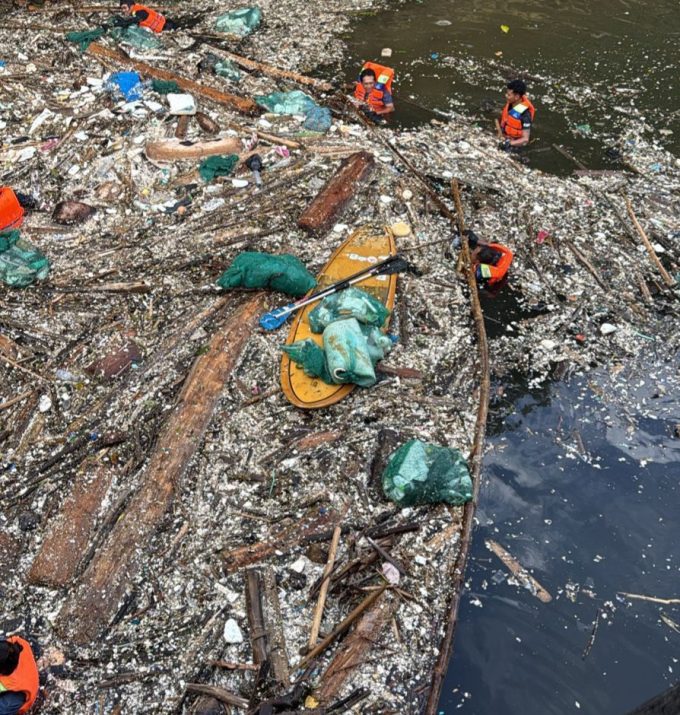
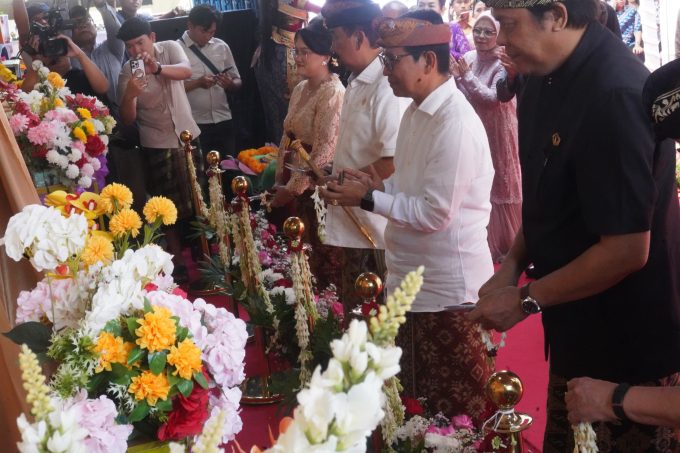
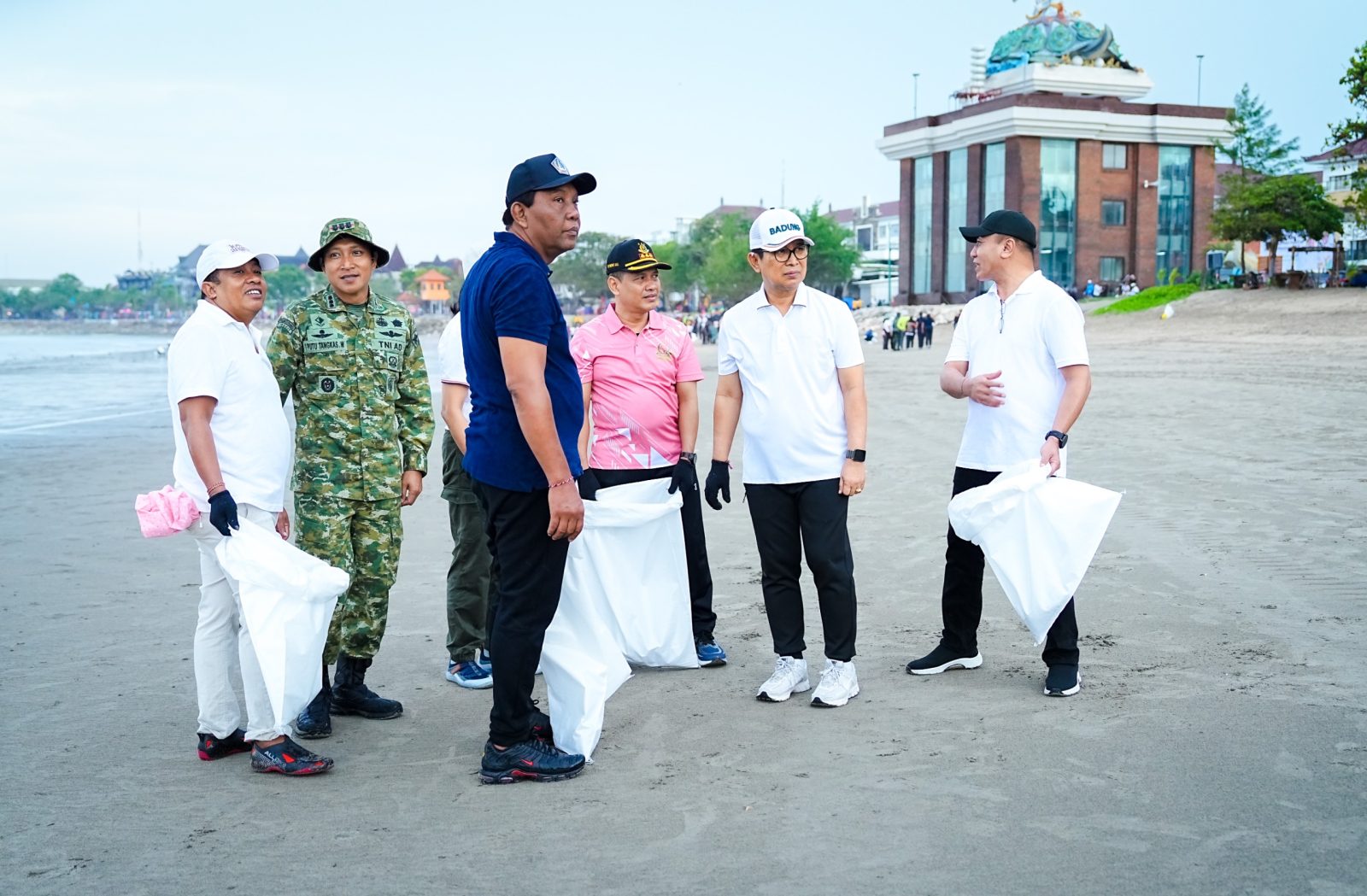
A coastal clean-up action targeting marine debris was once again carried out on Sunday (22/2). The activity, held as part of the 2026 National Waste Awareness Day (HPSN) commemoration, began with an assembly led directly by the Regent of Badung, I Wayan Adi Arnawa, and the Chairman of the Badung Regional House of Representatives (DPRD), I Gusti Anom Gumanti, at the Baruna Disaster Shelter, Kuta Beach.
It is worth noting that this commemoration serves as a reflection on the Leuwigajah landfill landslide tragedy on February 21, 2005, which marked a turning point in national waste management policy reform. Since that incident, the waste management paradigm has shifted from a linear collect–transport–dispose system toward an approach based on the 3R principles (Reduce, Reuse, Recycle) and a circular economy, reinforced through the national regulatory framework.
Carrying the theme “Collaboration for a Clean and Beautiful Indonesia (Indonesia ASRI),” this year’s event is expected to serve as a strategic momentum to accelerate the transformation of waste governance, particularly through an integrated and sustainable upstream-to-downstream approach.
The clean-up was not only conducted at Kuta Beach but simultaneously at several other coastal areas across Badung Regency, including Kudeta Beach Seminyak, Legian Beach, Jerman Beach, Kelan Beach, and Kedonganan Beach. Clean-up efforts were also held at the Batu Ngaus Temple area in Cemagi and the Putra Persada Sports Hall area in Banjar Angkeb Canging.
Reading the remarks of the Minister of Environment/Head of the Environmental Management Agency, Hanif Faisol Nurofiq, Regent Adi Arnawa stated that the government is moving under one grand vision: the National Movement for Indonesia ASRI (Safe, Healthy, Clean, and Beautiful). He emphasized that HPSN is not merely a ceremonial agenda but a crucial momentum to accelerate the resolution of national waste issues.
The national movement was officially launched by the President of the Republic of Indonesia, Prabowo Subianto, during the 2026 National Coordination Meeting of Central and Regional Governments. The movement is designed as an acceleration strategy to address what is considered a systemic waste crisis. The President stressed that old approaches are no longer sufficient, and extraordinary, massive, structured, and sustainable measures are required.
The movement places behavioral change as its main foundation, with waste management starting at the source—households, educational institutions, business areas, and government offices—through waste sorting, waste reduction, and optimization of intermediate processing facilities such as MRFs (Material Recovery Facilities), TPS 3R (Reduce, Reuse, Recycle Waste Processing Sites), and TPST (Integrated Waste Processing Sites).
If this collaboration succeeds, the burden of waste management is expected to be significantly reduced, including the state budget and environmental recovery costs due to pollution.
“Let us make the spirit of HPSN 2026 a turning point in our environmental transformation. By working together, we are confident that the waste problem can be resolved quickly and sustainably. Let us prove that a Clean and Beautiful Indonesia is not merely an aspiration, but a reality we pass on to future generations. Start today, from where you stand—fight waste for a Clean and Beautiful Indonesia,” Adi Arnawa emphasized while reading the Minister’s remarks.
After the event, Regent Adi Arnawa reiterated that waste issues can no longer be handled using conventional approaches. HPSN, he stressed, must be interpreted as an acceleration point for change.
“We can no longer rely on the collect-transport-dispose pattern. Waste management must begin upstream through disciplined and consistent sorting,” he asserted.
On the occasion, the Regent also noted that beach clean-up activities in Badung Regency are routine programs carried out every Friday, involving educational institutions, tourism stakeholders, communities, and civil servants (ASN) as a form of collective participation.
“In principle, the beaches have been cleaned. The challenge lies more in distribution and queues at the landfill (TPA). We have instructed intensive coordination so that transportation is carried out in stages, preventing the perception that beaches are unmanaged,” he added.
The Badung Regency Government, he continued, is also optimizing temporary processing facilities, including TPST Mengwi and TPST Padang Seni, to reduce waste residue sent to landfills to a maximum of 20 percent, in accordance with regulatory provisions.
“As a reinforcement of governance, we will hold a waste management competition starting March 1, 2026, covering 62 locations from 46 villages and 16 urban wards as a performance-based evaluation instrument as well as public education,” he explained.
The event was also attended by Badung DPRD Members I Nyoman Graha Wicaksana and I Wayan Puspa Negara, the Badung Regional Leadership Coordination Forum (Forkopimda), heads of regional agencies, vertical institutions in Badung Regency, community organizations, village/urban ward representatives, business actors, NGOs, and members of the public. TS-01